
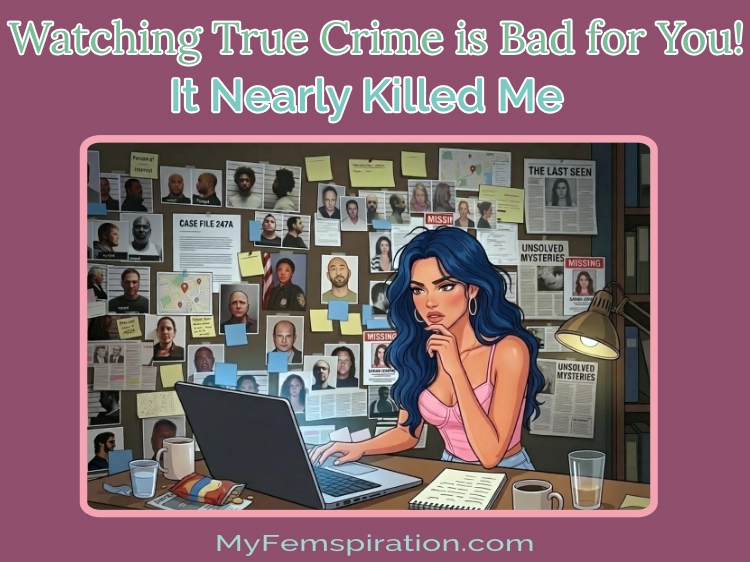
Watching True Crime is Bad for You! It Nearly Killed Me
We really need to talk about why watching true crime is bad for you.
It’s easy to call it a “guilty pleasure,” but our addiction to true crime is problematic in ways most people don’t realize.
I learned that lesson firsthand when my consumption nearly killed me.
Let me explain.
I’ve been hooked on true crime since I was about 6 years old.
I can still vividly remember watching reruns of the original Unsolved Mysteries, feeling that weird mix of pure terror and total fascination.
Every case burrowed into my brain… the who, the why, the how. I couldn’t get enough.
As I got older, the obsession only grew.
When the genre exploded in the 2010s, I was like a kid in a candy store, consuming every documentary and podcast I could find.
I was even one of those people who watched missing persons and murder cases to “relax”… falling asleep every night with crime stories playing on loop in the background because the calm narration somehow soothed me.
I told myself it was educational.
Like a lot of women, I felt like I was “preparing” myself for the worst-case scenarios life could throw at me.
But over time, things shifted.
I became paranoid about my surroundings, convinced that every stranger I passed was acting a little too suspicious.
I was living in a constant state of high alert that left me jumpy and anxious around the clock.
I realized just how serious the negative effects of true crime consumption had gotten one night while watching a compilation of horrific crimes.
The details were so graphic they made me squirm.
I didn’t even notice I’d started breathing shallow… even holding my breath at moments… until my chest went tight and my head started spinning.
I began to panic when my hearing faded to a high-pitched ring and my vision began closing in around the edges.
My body went limp and I was fighting to stay conscious, cycling through every breathing exercise I could think of while hoping I wasn’t actually dying.
Thankfully, a family member was there to help me through it, but it took 30 minutes of intense deep breathing before I felt anywhere near normal again.
This incident made me realize that my “hobby” wasn’t just a way to pass the time; it was a legitimate danger to my wellbeing.
What’s also scary is that I’m not the only one.
We’ve reached a point where we treat the most horrific moments of people’s lives like background noise for our chores or a lullaby to help us sleep.
We tell ourselves we’re just “staying informed,” our obsession with true crime is rotting our brains and distorting how we see the world.
It is super unhealthy how casually this genre is marketed to us now, and it’s time to look at the damage it’s doing under the surface.
Here is exactly how our true crime addiction is affecting us:
3 Reasons Why Our Addiction to Watching True Crime is a Problem
1. We Get Stuck in High Alert
Binging true crime is essentially training your brain and nervous system to stay in a cycle of anxiety that doesn’t switch off once the screen goes dark.
Because these documentaries and podcasts focus on gruesome, shocking details, our brains processes that information as a current threat.
This quickly turns into paranoia and hypervigilance.
We start fearing that we could be next, or that a general sense of danger is lurking around every corner.
This makes it almost impossible to truly relax, sleep deeply, or enjoy our lives without looking over our shoulders.
We begin to analyze every stranger’s “vibe” or obsess over whether our front door is locked for the 10th time.
We tend to excuse this as “being careful,” but this state of high alert wreaks havoc on our mental and physical health.
It leads to chronic stress, muscle tension, and a level of jumpiness that makes everyday activities feel like a minefield.
2. It Feeds Our Depression and Guilt
When our brain is on a steady diet of tragedy and violent endings, it becomes incredibly difficult to find meaning or happiness in our own lives.
This is especially dangerous if you’re someone who is already struggling with mental health.
These stories act as relentless triggers, compounding whatever you’re already carrying and making existing depression feel heavier.
Eventually, we start to feel powerless and small, convinced that we’re living in a dangerous, despairing world with no way out.
We also start to feel immense guilt.
When we become addicted to consuming the suffering of real people… real victims and devastated families… it’s hard to ignore the “ick” factor.
We feel bad for being entertained by it.
That guilt wraps itself around everything else we’re feeling, quietly feeding the depression and making it all just a little heavier than it was before.
3. We Stop Seeing Victims as Real People
The longer we stay immersed in these stories, the more desensitized we become.
What once made our stomach drop starts to feel ordinary.
The shock fades and the horror becomes background noise.
Without even realizing it, we stop seeing the victims as human beings and start seeing them as “characters” in a story we’re consuming for entertainment.
When that line between reality and entertainment disappears, true crime stops feeling like someone else’s tragedy and starts feeling like a puzzle to be solved for fun.
We start to feel like we have a personal stake in the investigation.
Many true crime fans become “internet sleuths” playing with real-life trauma, which often does more harm than good.
Fans frequently misinterpret evidence, spread misinformation, and harass innocent people.
By trying to “help” from behind a keyboard, internet sleuths can actually impede law enforcement and destroy lives, treating a family’s worst nightmare like a hobby.
For others, that blurred reality leads to romanticizing the killers themselves.
They begin treating them like celebrities or anti-heroes…obsessing over their psychology or their looks.
When that happens, the gravity of what these people did gets completely buried.
The victims become mere footnotes, and the lifelong suffering of their families becomes nothing more than a plot point in a fandom.
In Closing
True crime has cemented itself as a massive part of pop culture, and the negative effects are very real.
If your consumption has started to cost you your sleep, your peace of mind, or your ability to be happy in your own life, it’s time to be honest about what the obsession is actually doing to you.
Fill that mental space with things that engage you without making you constantly look over your shoulder.
That could be audiobooks, less triggering shows, or anything else that doesn’t leave you feeling scared and paranoid before bed.
If you genuinely care about justice, channel that focus into something that actually helps… like volunteering for an organization that supports victims or donating to a charity that makes a real difference.
If you find that you can’t shake the grip of these stories on your own, reaching out to a therapist or a support group isn’t an overreaction.
Breaking free from being a “murderino” armchair detective and reclaiming both your life and your sanity is one of the best things you can do for yourself.
Want More Like This?
Join my email list to have deep, honest, and sometimes messy conversations about life and womanhood… delivered straight to your inbox.
💕If this blog has ever helped you feel seen or supported, you can also leave a tip below. Every dollar helps keep MyFemspiration alive and growing.


You May Also Like
