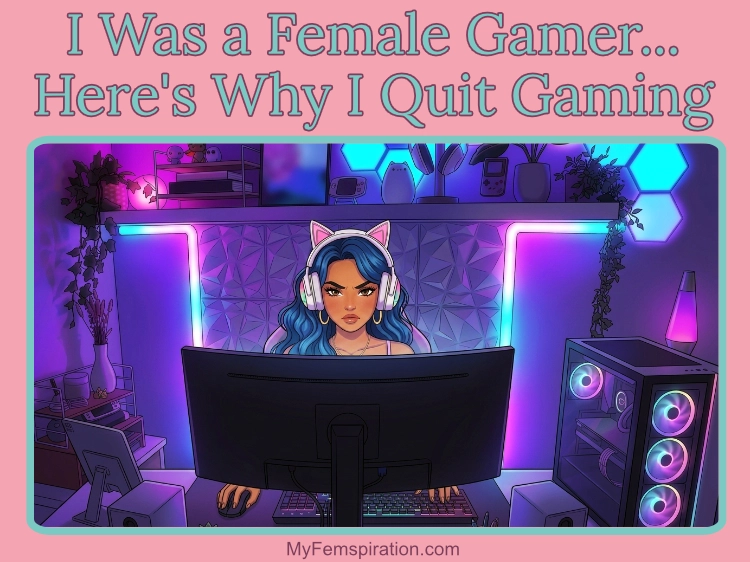
I Was a Female Gamer… Here’s Why I Quit Gaming
When people would say gaming is a waste of time, I used to roll my eyes.
To me, those people were boring or just didn’t get it.
I also side-eyed every friend who suddenly “retired” from the hobby because they decided it was time to “grow up.”
It felt performative… like throwing away something they loved just to prove they were real adults.
I swore I’d never be that person.
I loved gaming and took pride in my skill.
I put in thousands of hours and could hold my own against a multitude of men as a female gamer.
Plus, I was shy and socially awkward growing up.
Socializing in games helped me find my personality and experience what it felt like for people to think I was cool and enjoy having me around.
I became an online social butterfly with hundreds of gaming friends who I could spend hours chatting with or having fun working toward an in-game goal.
But after years of living the gamer lifestyle, the negative aspects started getting to me… and I slowly realized gaming isn’t fun anymore.
It became so obvious how much time and life I was throwing away.
Because while Delana the gamer felt skilled and accomplished, my reality was running on autopilot… and seeing how stagnant my life had become made me sit down and ask myself: Should I quit gaming?
I stopped forcing myself to game out of habit or social obligation, only jumping on when I REALLY wanted to… which turned out to be hardly at all.
Almost immediately, I could feel how quitting gaming changed my life.
And now that it’s been years since I left it behind, I can positively say the benefits of quitting gaming have been incredible.
Here is everything I realized after I quit… and why I’m never going back to the gamer girl lifestyle.
1. The Toxicity Wasn’t Worth It Anymore
One thing every gamer encounters, but that I always despised, was the toxicity of online communities.
As a female gamer, I faced rampant racism, sexism, and misogyny when I was simply trying to enjoy a game.
I had to constantly deal with insecure males who talked down to me or actively tried to ruin my good time just because they felt a woman shouldn’t be in their lobby.
If I made a mistake, those guys would verbally abuse me, and if I outplayed them, they’d get angry, accuse me of cheating, or blame their deaths on me.
I felt like I had to perform perfectly at all times just to minimize the target on my back, but the abuse was guaranteed either way.
Gaming was supposed to be a way to relax, but the rampant toxicity always made me feel underlying stress and anxiety instead.
2. It Was Destroying My Body
For the longest time, I loved the thrill of clutching a hard match or fighting for my life in a round.
My hands would shake, my heart would race, and eventually I’d break out in a cold sweat… but for years, I thought that was just what good gaming immersion felt like.
I fully believed gaming was a fun, adrenaline-filled escape.
What I didn’t notice over time was that this constant rush was slowly stressing out my nervous system while I ignored serious signals.
Even though I tried avoiding toxic players as much as possible, it was an inevitable, normal part of gaming culture.
This led to my anxiety and depression getting significantly worse from dealing with rude, racist, and sexist people on a regular basis.
And gaming wasn’t just mentally damaging… I was also physically hurting my body by sitting on my ass for hours every single day.
Years of that sedentary lifestyle eventually caught up with me in the form of back pain, sciatica, weight gain, and wrist pain.
When I finally quit and started making time for myself… going on walks, lifting weights, caring for my body, and putting effort into how I looked… my body got way stronger, and my mental health drastically improved.
3. I Was Investing in Nothing
It’s crazy to look back at how much time and money I dedicated to fake progress.
I spent thousands of dollars buying an extensive library of games, expensive DLCs, tradable items, skins, and profile customizations.
At the time, I justified every purchase by telling myself it helped me enjoy the game and gave me a unique online identity.
As someone who is self-employed, I cringe at how I used that flexibility to level up, hit achievements, and beat hard bosses… instead of putting real effort into making money and solidifying my brand.
I often only did the bare minimum just so I could hurry up and get back online to play.
Gamers often swear that grinding for thousands of hours is “real progress,” and that they’re building valuable career skills like quick reflexes or high-pressure problem-solving.
But while that may get them far in a pixel world designed by developers, the translation to actual real-world work ability is almost non-existent.
4. Life Was Passing Me By
Gaming tricked me into believing I was living a full life when I rarely stepped outside.
I always felt like I had plans and an active social life, when really I was just comfy in my living room… hanging out in Discord and running matches for hours at a time.
As the years slipped by, I realized that while I was busy staring at a screen, my family was getting older… some even passed away.
Friends in the real world eventually stopped inviting me out because I was always “busy” or preferred staying home to play.
I constantly neglected household duties, missed out on life opportunities, and wasted my youth.
It was cozy in the moment, but looking back, being a gamer cost me moments and people I can never get back.
5. The Community Was an Illusion
Many gamers will tell you that spending hours online is just as much about community and lifelong friendships as it is about playing games… and I would’ve agreed.
I loved my gaming friends and even considered them real friends.
We spent thousands of hours playing memorable matches together or sitting in Discord chatting about everything under the sun.
But over time, I noticed a pattern in how online gaming friendships actually work.
A new game would drop, and people I once considered besties would move on to a new friend group and act like I never existed.
With others, I realized that if we weren’t hyping up new releases, complaining about devs, or gossiping about the player base, we had nothing to talk about.
In fact, many of them were keeping me hooked by pressuring me to play “just one more game” or “blow it off until later” when I needed to get work done or go to bed.
When I decided to quit gaming, not many of them noticed, and only a few really understood.
Some of them talked to me like I was the weirdo… suggesting I just needed to try new games, find new friend groups, or practice moderation.
Some even acted as if my desire to quit was offensive.
6. I Didn’t Want to Grow Old With Nothing to Show For It
The most eye-opening realization is how sad being stuck long-term can actually be.
I have gaming friends who are now in their 30s, 40s, and 50s whose entire world still revolves around online drama, patch notes, grinding for hours, and having the best gear.
Worse, many of them struggle financially but will still take out loans for new graphics cards, PCs, or consoles.
Others have never had a real job and have spent the last decade streaming to the same 3 viewers… convinced they’re still just one viral clip away from becoming the next CaseOh.
A lot of them, while perfectly nice, haven’t paid much attention to their mental health, becoming financially stable, or doing anything that actually moves their lives forward.
Gaming is still their entire personality, and they act like it’s all they need or desire out of life.
No disrespect to them, but I realized that wasn’t who I wanted to be.
In Closing
To be clear, I’m not writing this to look down on anyone.
I’m sharing this because I know a lot of people are stuck feeling unfulfilled and drained, unable to see that gaming might be a huge reason why.
Gamers usually write off any criticism as just a “hater” who doesn’t get it.
But I loved gaming, and I spent years not realizing just how much it controlled my life.
Gaming is so easy to get hooked on because it was designed to be extremely addictive.
It provides constant dopamine, gives a feeling of accomplishment, comes with a built-in community, and always offers something new to chase.
We justify the lifestyle because why struggle out in the real world when we can achieve so much while relaxing in a chair?
I genuinely feel happier, more confident, and way more fulfilled after quitting because I’m spending my time leveling up my existence in the real world rather than another digital open world.
Sure, I might boot up my Steam account again someday… but I’m done letting gaming be my identity and sucking my life away.