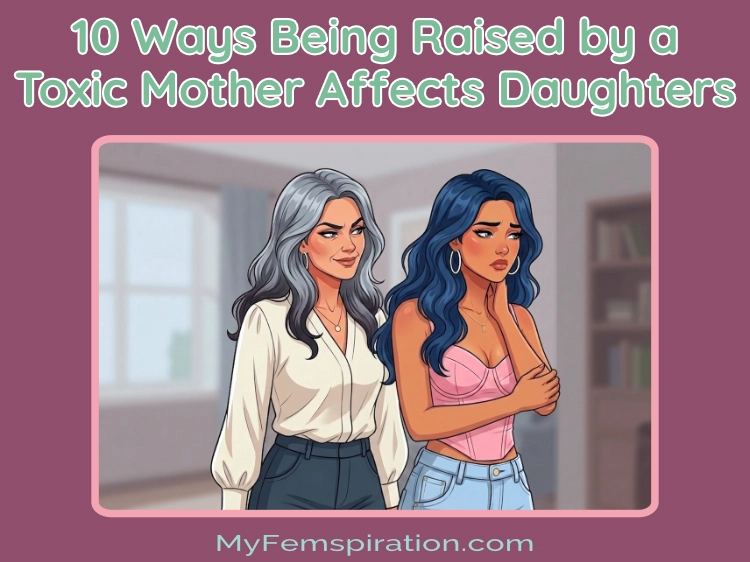
10 Ways Being Raised by a Toxic Mother Affects Daughters
We hear a lot about daddy issues… how a distant or harmful father can shape a woman’s self-worth, her relationships, and the way she sees herself in the world.
But we rarely talk about the quiet destruction of mommy issues.
The reality is that being raised by a toxic mother who was cold, critical, or controlling doesn’t just mess with your childhood.
It carves out a mother wound that shows up in how quickly you apologize, how desperate you are to be chosen, and how terrified you are of taking up too much space.
For a long time, I didn’t connect my own patterns to my narcissistic mother.
I thought I was just anxious, or too awkward, or maybe it really was about my dad… the way women’s pain usually gets explained away.
But the older I got, the harder it became to ignore the constant self-doubt I felt after being around her.
I felt like I was never quite enough, no matter how much I achieved.
Even a specific look or tone of voice could trigger me, making me feel like a helpless little girl all over again.
As I grew and my mother’s habits didn’t change, I started to realize these weren’t character flaws.
They were adaptations I built around a woman who should have made me feel safe, but never did.
If you’ve spent years trying to fill a void you couldn’t even name… constantly wondering why intimacy feels so complicated, why you crave validation so intensely, or why love always feels like something you have to earn… you aren’t alone.
I am sharing 10 signs of being raised by a toxic mother and exploring how these behaviors affect their daughters… and how, if left unchecked, they can ruin our lives.
10 Signs You Were Raised by a Toxic Mother and Mistook it for “Normal”
1. Craving for Constant Validation
Growing up in a home void of real affection is a reality that almost every woman raised by a toxic mom understands.
As the daughter of a narcissistic mother, I never knew what it felt like to be truly loved.
My mom wasn’t the kind of woman who gave hugs or offered kind words… maybe she did for others, but never for me.
In fact, I can’t recall a single time she said, “I love you.”
Not even once.
I honestly believe it’s because she knew it would be a lie.
And not only did she withhold love and affection from me, she often allowed others to mistreat and alienate me.
If adult relatives mocked me or crossed boundaries, she let it slide.
If I came home crying from being bullied at school, she brushed it off or told me to ignore it.
It was like she didn’t care who hurt me because she thought it would teach me to be tougher and more self-sufficient.
But that kind of neglect didn’t make me strong.
It created a mother wound that made me feel broken.
Like maybe I didn’t deserve to be protected or loved at all.
I started to believe I was just someone for others to ignore, use, or laugh at.
So I spent years desperate for attention, validation, and affection.
If someone showed interest in me… even if it was the wrong kind, like purely sexual or shallow… it still felt like proof that I mattered.
Like maybe I wasn’t so unlovable after all.
2. Navigating Life Without a Safety Net
If you have a mother wound, you probably spent your childhood—and your adulthood—feeling like you had to navigate life with no support.
I wasn’t taught how to function, make decisions, or handle life’s challenges—I was just expected to figure it all out on my own.
And if I got it wrong, I was mocked, criticized, or punished.
When I struggled, my mom didn’t offer guidance or comfort.
She’d roll her eyes, get irritated, or dismiss me with, “You better figure it out.”
My problems weren’t taken seriously; they were treated like annoyances.
On the rare occasions she did step in, her “help” only made things worse because it was cold, condescending, and laced with humiliation.
She made sure I knew I was a burden and that she was only helping out of obligation, not love.
Over time, I learned that asking for help meant opening myself up to shame.
I internalized the idea that struggling meant I was stupid or weak.
I became terrified of making mistakes… not just because they might set me back, but because I believed someone would be watching, waiting to laugh when I failed.
Even now, as an adult, I’m harsh on myself.
I’m afraid to fail in front of others or even try new things, because deep down, I still expect to be ridiculed for getting it wrong.
3. Taking Responsibility for Other People’s Emotions
I noticed early on that narcissistic mothers have a way of conditioning their daughters to take the blame for everything… even things that weren’t your fault.
No matter how big or small, if something went wrong, my mom always found a way to pin it on me.
She’d say I should’ve stopped her, spoken up, or “educated her” ahead of time.
I remember her constantly saying things like, “You should have told me this would happen,” or “Why did you let me do that?”… even over something as small as missing the street she was supposed to turn on.
It was like managing her life and emotions was somehow my responsibility, even as a child—and well into adulthood.
Over time, I started accepting blame for things that weren’t my fault.
My mom taught me it was noble—even virtuous—to take the fall for others, to keep the peace, to let others win or take the credit while I stayed in the background.
I was taught that wanting recognition, attention, or success made me selfish.
So I sacrificed. Constantly.
I became a chronic people-pleaser… always apologizing and trying to make things easier for others, even if it cost me my dignity or happiness.
I didn’t know how to advocate for myself, because deep down, I truly believed that putting myself first made me a bad person.
And for a long time, I couldn’t see how that mindset was holding me back.
I stayed stuck in one-sided relationships, let people use me, and held myself back from the wins I wanted in life… all so I could feel like I was being “kind.”
4. The Lifelong Struggle with Body Image
Your first critic likely wasn’t a magazine or a mean girl at school … it was your mother planting seeds of negative body images in your head.
From as young as 7, my mom would tell me I was too fat and needed to lose weight.
She made jokes about my appearance, called me names, and accused me of eating too much… even though she was the one buying the junk food and preparing most of our meals.
I also got teased for the way I walked, talked, or simply moved through the world.
The criticism never let up.
As I got older, there were constant reminders that I wasn’t good enough.
That I could be slimmer, prettier, more “put together.”
Her voice lived in my head, nitpicking every perceived flaw.
To this day, I still struggle with eating disorders, body dysmorphia, and a deep sense of shame about my appearance.
I feel like I’m constantly being watched—like someone is silently picking me apart the way she did.
I rarely feel relaxed in my own body.
I’m always bracing for criticism, even when no one’s saying a word.
5. Internalized Misogyny and Quiet Competition
Some women with toxic mothers are raised to see other women as rivals, not allies—creating a lifetime of quiet competition and internal misogyny.
From as early as 5 years old, I was taught to size up other girls.
If one walked in with longer, shinier, better-styled hair, my mom would lean down and whisper, “Is her hair longer than yours? Do you think it’s all real?”
It wasn’t just commentary—it was training.
I learned that if another girl was beautiful, confident, or popular, I wasn’t supposed to admire her, befriend her, or compliment her.
I was supposed to pick her apart and compete.
My mom encouraged me to invalidate women who got too much attention or success.
In her mind, women were inferior… too emotional, not smart, not to be taken seriously.
So if another woman got ahead, there had to be a reason… maybe she flirted, or used her looks, but she didn’t really earn it.
I was also taught not to show grace or kindness to other girls.
Instead, I was expected to hold them to impossibly high standards… while secretly hoping they’d fall short.
Whether it was cousins, classmates, or complete strangers, my mom made it feel like another woman had to lose in order for me to win.
So if another girl stumbled, it was something to quietly celebrate, because her pain made room for me.
Conversely, if they “won” more attention, I was expected to feel jealous and bitter, because their success was “proof” that I wasn’t enough.
Over time, I started to internalize the idea that being a woman was somehow shameful… or even a joke.
Like we all deserved to be judged, criticized, or bullied, because only a select few would ever be seen as “good enough” to deserve real support or respect.
To cope, I learned to distance myself from other girls and went out of my way to prove I was better than them.
It took me a long time to realize I was allowed to feel good about myself without needing to tear anyone else down.
6. Viewing Every Choice as “Life or Death”
A lot of us move through the world in a state of constant fear because we were raised by women who projected their own paranoia and anxiety onto us.
As the daughter of a narcissistic mother, I was raised to believe that everything outside our bubble was dangerous and every decision I made was probably wrong.
My mom was always anxious, always convinced the world was out to get us.
According to her, any step I took outside her control came with catastrophic risks.
If I went out with friends, I might get abducted, raped, or killed.
If I traveled, I might die in a car crash or plane wreck.
If I tried something new or strayed too far from our norm, something would definitely go wrong.
Living in that constant state of doom made it nearly impossible to trust my own instincts.
Every choice felt like life or death, and every move felt inherently risky.
And I was made to believe I was too dumb or naive to protect myself without her constant guidance.
Even now, as an adult, I still carry that fear in my mind.
I’ll leave the house and instinctively brace for the worst… as if something traumatic is just around the corner, waiting to happen.
7. Doubting Your Own Decisions and Future
One of the most painful traits of women with toxic moms often carry is the fear of functioning on our own… because we were taught we couldn’t.
Growing up, I wasn’t just controlled, I was conditioned to believe I couldn’t handle life without my mother’s input.
She micromanaged everything.. my thoughts, my values, my future.
If I had dreams she didn’t approve of, they were mocked.
If I made a decision without her, it was guaranteed to be “the wrong one.”
Even as an adult, she expected me to run everything by her… who I dated, how I raised my child, what steps I took in life.
And no matter what I chose, she always had something negative to say… something subtle or cutting, meant to plant doubt.
That kind of control left me struggling to fully trust that I knew what was best for me without getting validation from someone else first.
And anytime I made a mistake, it wasn’t just my fault—it was proof that I should’ve listened to her all along.
8. Feeling Shame for Having Ambition
For many daughters of narcissistic mothers, our success was never a cause for celebration.
It was either brushed off as meaningless or treated like a direct threat to her ego.
As the daughter of an elderly narcissistic mother, I learned early on that my accomplishments didn’t matter.
Whenever I got excited about something I loved, she’d find a way to tear it down.
If I was proud of a creative project or hopeful about a new opportunity, she’d scoff, roll her eyes, or offer a passive-aggressive jab to remind me it was nothing to get excited about.
When I started pursuing a career as a freelance creative, she told me I’d never make it.
Instead of supporting my vision, she insisted I was a perfect fit for “practical” jobs like a retail greeter or an office clerk.
Even when I told her I wanted to go back to school, she shut me down instantly.
“You’re too old,” she said. “Too unstable. You’ll never finish.”
Her words were devastating… but what hurt even more was realizing that nothing I did would ever make her proud, or count as a real accomplishment in her eyes, because she didn’t want me to succeed at all.
9. Being Actively Held Back from a Better Life
I’ve seen how many of us weren’t just discouraged from dreaming big; we were actively held back by mothers who couldn’t handle the idea of us having a better life than they did.
Anytime I showed promise—good grades, a better job, a nicer apartment—my mom would get jealous, downplay it, or try to sabotage me.
If I caught a financial break, she’d accuse me of being lazy.
If I spent wisely, she’d say I was cheap and should splurge.
She only seemed satisfied when I was overwhelmed and financially struggling… just like her.
And that truth became undeniable the day she proudly announced she had removed me as her life insurance beneficiary and replaced me with a distant male relative.
She made it clear she wasn’t concerned about my future.
In fact, she seemed almost pleased at the thought of me struggling.
And sadly, I’ve since learned this isn’t rare.
Some narcissistic mothers hold their daughters back in quiet, subtle ways… discouraging education, pushing low-paying jobs, sabotaging relationships, or convincing us we’re not capable of success.
Others go even further, cutting their daughters out of inheritances to make sure they stay financially stuck.
For these mothers, it’s satisfying to see their daughters overwhelmed, struggling, and dependent… just like them.
10. The Stunted Ability to Advocate for Yourself
One of the most damaging things daughters of narcissistic mothers go through is being constantly gaslit.
We are told our feelings are overreactions, our memories are wrong, or that we’re the ones causing all the problems.
For me, it became glaringly obvious how far my mother would go to twist reality when she used her decision to cut me out of her life insurance as a weapon.
When she told me I was “too unstable” and “spoiled” to be listed, I broke down sobbing.
She didn’t offer comfort; she just smirked.
She watched me fall apart in real time and used my pain to justify her cruelty and paint me as mentally unwell.
“See?” she said. “I told you you’re crazy. And money-hungry, too.”
Sadly, this wasn’t anything new.
Like many narcissistic mothers, mine denied the things she said or did whenever I brought them up.
It was always, “That never happened.”
“I don’t remember that.”
“I’d never say something like that.”
And if she did acknowledge it? She made it my fault.
“You made me angry.”
“You’re too sensitive.”
“You misunderstood me.”
No matter how calmly I tried to speak up, I was always shut down or treated like I was just trying to start drama.
So eventually, I stopped speaking up at all.
And I truly believe that stunted my ability to stand up for myself or advocate for my needs.
Because when your feelings are always dismissed, your voice always silenced, you stop expecting to be heard.
You start staying quiet and avoiding conflict because you already know how the story ends.
You’ll always be the villain.
In Closing
If anything here felt familiar, I hope it offered more than just a clinical definition for what you’ve been carrying.
The reality of growing up with a narcissistic mother is that so much of the damage is quiet and normalized.
It hides inside habits and thought patterns you assumed were just part of who you are… not realizing how much of how you love, how you work, and how you speak to yourself was shaped by surviving her.
But recognizing it matters… not so you can spend your life looking backward, but because you can’t untangle yourself from something you haven’t learned to see clearly yet.
You are not the version of yourself she decided you were.
“Sensitive,” “unstable,” or “not enough”… those were her limitations, not your truth.
The mother wound doesn’t heal overnight, and it doesn’t disappear just because you understand where it came from.
But awareness is where the shift begins.
The fact that you’re here, asking these questions, means the narrative is already changing.
You survived her… and the next part is finally getting to build a life, an identity, and a purpose that actually belongs to you.
Want More Like This?
Join my email list to have deep, honest, and sometimes messy conversations about life and womanhood… delivered straight to your inbox.
💕If this blog has ever helped you feel seen or supported, you can also leave a tip below. Every dollar helps keep MyFemspiration alive and growing.